

Alright, let's do this. I've been putting this off for years..There's a difference between carrying a story and actually setting it down somewhere, and I've been carrying mine for longer than I'd like to admit.
I've always believed that every person carries a story worth telling. For years I wanted to write mine, but life has a way of convincing us there will always be more time. Eventually I realised that stories aren't preserved by memory. They're preserved by telling them. So here I am, finally writing my first blog.
As I've reflected on the journey behind me, one truth has become increasingly clear: God was far more involved in my story than I realised at the time. Looking back, I can see His fingerprints on moments I once considered ordinary. Conversations, churches, prophetic words, disappointments, unexpected turns. All of it became part of a puzzle in a way only He could see in its entirety.
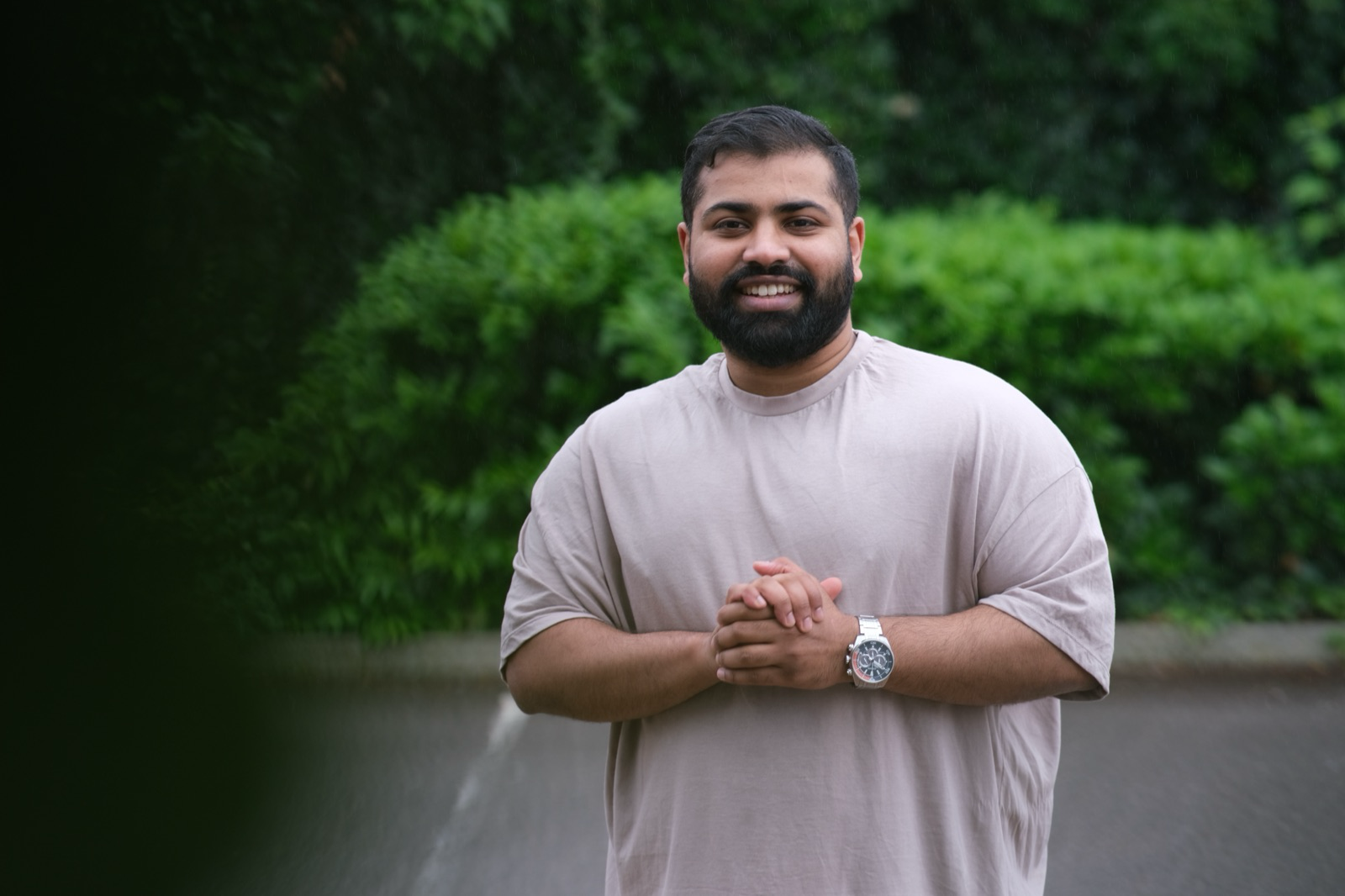
This is my attempt to look at the pieces. Before I get to the dramatic chapter, how I came to truly know Christ, I want to honour the quieter work of God, the years He spent patiently preparing me long before I understood what He was doing. My name is Aben Mathew. I'm a Christian, a husband, a dad, and a British Malayali who grew up in Dammam, Saudi Arabia, before moving to the UK in 2005.
Life, as I see it, is a story. A narrative that starts the moment we take our first breath and unfolds with each passing day. But as I've journeyed through mine, I've come to realise my story has two authors. There's the one I try to write, with all my plans, decisions, and dreams. And then there's the true Author, God, whose pen has been gently but purposefully scripting a far greater narrative. One I often didn't understand in the moment but can now see a little clearer than yesterday.
This is the first of two parts. In the next one, I'll share the moment everything changed, when I handed the pen of my life over to Jesus, the One who knows my story best. But before we get there, let me take you back to the beginning.
Growing up in Saudi, I remember watching an old film called Mathilukal (Walls) by Adoor Gopalakrishnan. It's based on the autobiographical novel by Vaikom Muhammad Basheer, and it features Mammootty as Basheer, a prisoner who falls in love with a female inmate, Narayani, whom he never actually sees. One line from that film has stuck with me for years. Basheer remarks that everyone can write one book in their life: their life story. That idea has never really left me. Life is a story, one that began when we were born and is still unfolding right now, in this moment. It reminds me a little of Descartes, "I think, therefore I am." Once you become conscious of that, you're forced to ask: who is writing the story? Am I writing the story of my life, or am I playing a role in a bigger one? Big question. Probably an even bigger answer.
I was born into a nominal Christian household, so God was always part of our lives. There was never really a question of whether God existed. It was more a question of who He was. For that, I'm thankful to my parents. We lived on the top floor of a three storey building in Dammam. Our neighbours on the middle floor were a family of five, born again Christians, who held Friday Bible classes in their home (Friday being the weekend there, the way Sunday is here). They were kind and bold enough to invite the children living above them into their Brethren fellowship. That's where the seeds of the gospel were first planted in my life and my sister's.
I didn't know it then, but that was Him picking up the pen.
A few years later, my father decided the Protestant setting wasn't where he wanted us growing up, and he introduced us to the Orthodox prayer gatherings in Dammam instead. That was its own formative season. I still remember the zeal of those Orthodox fellowships. My mother, meanwhile, always longed for a more charismatic expression of prayer, so she'd also take us to ecumenical charismatic meetings on Friday nights. Those meetings were wild, full of prophecy and genuinely good teaching. They shaped how I learned to hear God's voice, especially through the ministry of a prophet named Raju Philip. Over the years, those gatherings became the foundation of our spiritual life. One evening, my mother received a prophetic word that God had prepared a nursing role for her in a national hospital in the UK.
Another line He was writing that I couldn't read yet.
Fast forward to 2004, and my mother stepped out in faith and began the application process to work as a nurse in the UK. It required complete reliance on God's guidance, and as a family we watched Him be faithful to that word, step by step. She started at a nursing home in Southampton, then within a year moved to Sheffield to work at another. By 2006 she'd begun her role at the Northern General Hospital in Sheffield, where she's served faithfully ever since and is set to retire in two years, God willing.
There's His handwriting again, plain as anything, if you know how to look.
I want to pause here on two things: what this journey has taught me about my own faith, and what it's shown me about the God who keeps His promises.
What I Carried From Each Season!
Each season of my life brought something different to how I understood faith. The Brethren assembly gave me the Bible in a deeply personal way, an individual relationship with God. The Orthodox gatherings gave me a real appreciation for tradition, liturgy, and the communal weight of the church. The charismatic meetings back in Saudi opened my heart to the Spirit as something dynamic and present, not theoretical. And from 2009 onward I've been in Pentecostal churches, serving and growing there. Every tradition gave me something the others didn't: the intellectual rigour and scriptural grounding of the Brethren, the historical depth of Orthodoxy, the Spirit led worship of the Pentecostal movement. I found John Wesley's idea of Scripture, tradition, reason, and experience as sources of theological reflection genuinely helpful for making sense of it all, not as four separate boxes but as four things that had actually shaped me: Scripture from the Bible classes and liturgical readings, tradition from the creeds and confessions I grew up hearing, reason from wrestling honestly with Reformed and Pentecostal thought side by side, and experience from the moments God met me directly and made faith something felt, not just believed.
One thing I've come to love about the Orthodox tradition is its understanding of the Trinity, the mystery and communion within the Godhead, Father, Son, and Spirit existing in perfect unity and love. Their role in the canonisation of Scripture matters to me too. The care the early church fathers took discerning and compiling the canon is a real inheritance, a reminder of how much tradition and collective wisdom matter in the Christian faith. Reformed soteriology has shaped me just as deeply, especially the emphasis on God's sovereignty and the doctrines of grace, the Five Solas: Scripture alone, faith alone, grace alone, Christ alone, to the glory of God alone. I dug into that tradition more seriously during the COVID years. And Pentecostal pneumatology gave my faith its pulse, the Spirit's active presence in the believer's life and in the church, the gifts, prophecy, healing, tongues, all of it a reminder that God is not distant.
Christian history is full of denominations clashing over how to read the same faith, but we have the benefit of hindsight now. We can look back and see the strengths each tradition carried, and where each fell short, and let that teach us something instead of just picking sides. I don't want to be a chameleon, changing shape to fit whatever room I'm in. I want a faith that's genuinely mine, shaped by a wide range of traditions and experiences without losing its convictions. This is part of what my journey has taught me about the body of Christ. Theological diversity, held rightly, doesn't fracture the truth. It gives you a fuller picture of God, His people, and how He's been revealing Himself through history.
What I've Learned About How He Speaks!
The other thing I keep coming back to is the power of God's word, and how faithful He is to what He promises. Scripture uses "the Word of God" in more than one way, and sitting with that has meant a lot to me. Sometimes it means Jesus Himself. Revelation calls the risen Lord "The Word of God," and John's gospel opens the same way: "In the beginning was the Word, and the Word was with God, and the Word was God." But John doesn't just say the Word became flesh and lived among us. The word he actually uses for "lived" is skenoo, to pitch a tent, to tabernacle. That's not incidental. For centuries God's presence had lived among Israel in an actual tent, the tabernacle, then later the temple, always mediated, always behind a curtain. John is telling us the Word didn't just visit. He pitched His tent among us the way God's presence once pitched its tent in the wilderness, except this time there was no curtain. You could touch Him. That's what "God with us" actually cost, and actually meant. Sometimes "the Word of God" means His decrees, the words that bring things into being. "Let there be light," and there was light. Hebrews tells us Christ still upholds the universe by that same word of power. Sometimes it's God speaking directly to a person, the way He spoke to Adam in the garden or gave the Ten Commandments at Sinai, words carrying the full weight of His authority. Sometimes it's God speaking through human lips, through prophets, fully authoritative when it's genuinely His word, the way He told Moses He'd put words in a coming prophet's mouth. And prophecy still happens today, but it doesn't carry Scripture's authority. Scripture is the standard everything else gets measured against, because prophecy comes through fallible people and has to be tested. Paul says it plainly in 1 Thessalonians: don't despise prophecy, but test everything, hold on to what's good. That testing is a communal thing, done with humility and dependence on the Spirit, checking whether a word lines up with Scripture, reflects God's character, and bears good fruit. When it does, you can receive it as a real, timely word from the Lord. When it doesn't, you let it go. And finally, God's words come to us written down, like the commandments carved by His own finger, and the Bible as a whole: not just a historical record but the living word of God, still accessible, still reliable, still authoritative.
Scripture isn't just ink on a page. It's living when the Spirit breathes on it, the way He turns words on a page into something that speaks directly into your life. Think of Peter in Luke 5. He's sceptical, but he obeys Jesus' word to cast the net anyway, and it becomes a turning point in his whole story. My mother's prophetic word worked the same way. It wasn't just encouraging, it was directive. It asked for faith to step into the unknown, trusting the God who spoke it would also do it. Hebrews tells us Jesus upholds everything by the word of the Father's power, which means every promise, every prophecy, is held up by His authority, not ours. When God gives a word, whether it's Noah building an ark or Abraham setting out for a land he'd never seen, it's not a random verse. It's a specific revelation carrying divine purpose. Romans says faith comes by hearing, and hearing by the word of God, a rhema word, something personal and direct. Isaiah 49:6 was written centuries earlier as a promise about the coming Messiah: "I will make you as a light for the nations, that my salvation may reach to the end of the earth." It's about Him. But when the Jewish leaders in Pisidian Antioch reject Paul and Barnabas's message, Paul and Barnabas quote that exact verse and apply it to themselves: "for so the Lord has commanded us." A word spoken about the Messiah becomes, centuries later, a specific commission handed to two missionaries in a specific city on a specific day. That's the difference between reading a promise and receiving one. The text didn't change. What changed was that the Spirit took a general word and made it personally, currently theirs.
Walking with God means learning to know that living Word and letting Him speak directly into whatever you're facing. That takes time in His presence, listening, discerning His voice. Faith isn't just belief. It's a response to a word that's actually been spoken to you. But circumstances will test that, and it helps to remember His faithfulness was never tied to how things look right now. His promises hold regardless of what we're walking through. When I need reminding of that, I go back to a few things. I recall what He's already been faithful to, the way my mother's move to the UK began with a prophetic word and God saw it through. I remind myself His nature doesn't change, "Jesus Christ is the same yesterday and today and forever," so His promises are just a reflection of who He already is. I try to keep an eternal perspective, the way Paul does in Romans 8, weighing present suffering against a glory that's coming and finding it isn't even close. I seek His presence directly, through prayer, worship, His word, and let the Spirit bring His promises back to mind. And I stay close to people who believe the same things I do and remind me of it when I forget, the way sharing my mother's story might encourage someone else the way it's encouraged me.
Looking back, my mother's journey was anchored the whole way through by that one prophetic word. It was a path of obedience, often walked in uncertainty, but every step was held up by the assurance that the God who promised is faithful. It shaped her life, and it's been a testimony to our whole family and everyone around us. So let's hold on to what God shows us, past or present, the way we'd hold something incorruptible, a seed of His promise. And as we keep walking with Him, let's keep listening for fresh direction, standing not only on the written word but on the living one, still active, still speaking. That's what all of this comes down to. He speaks, and it happens. He commands, and it holds.
I think about this now watching my own son, Jeremiah, ask his own questions, the kind that are far too honest for how simple they sound. I wonder what fingerprints he won't notice until he's my age, telling his own version of this.
This is just the beginning. In the next part, I'll tell you about the most life changing chapter of my story, the moment I stopped being the sole author of my own life and let the nail pierced hands of Jesus take the pen. That encounter came after two years of following Islam, and it's when I truly felt the authorship of my life pass from my hands into His. Until then, take a moment to reflect on your own story. Look for the hand of the Divine Author already at work in it, and trust that His narrative, whatever chapter you're in, is one of grace, redemption, and purpose.
Grace and Peace,
Aben
0 Comments